Why Traders Should Watch Memristors:
The Next AI Hardware Revolution?
Artificial intelligence has quickly become one of the biggest investment themes in global markets. What began largely as a story about software and AI models has expanded into a much broader technology cycle, driving demand for semiconductors, advanced memory, networking equipment, data centres and electricity.
As the AI industry continues to scale, a critical question is emerging: How can AI systems become more powerful without computing costs and energy consumption rising at the same pace?
One technology attracting growing attention is the memristor.
Memristors remain an emerging technology. They are not replacing the GPUs powering today’s AI boom, and there is no guarantee they will become a mainstream component of future computers. However, their potential to combine information storage and processing could change how certain types of computing are designed.
For traders, that makes memristors a technology worth watching. If the technology becomes commercially viable, it could eventually influence the economics of AI hardware, semiconductor competition and the companies developing the next generation of computing systems.
What Is a Memristor?
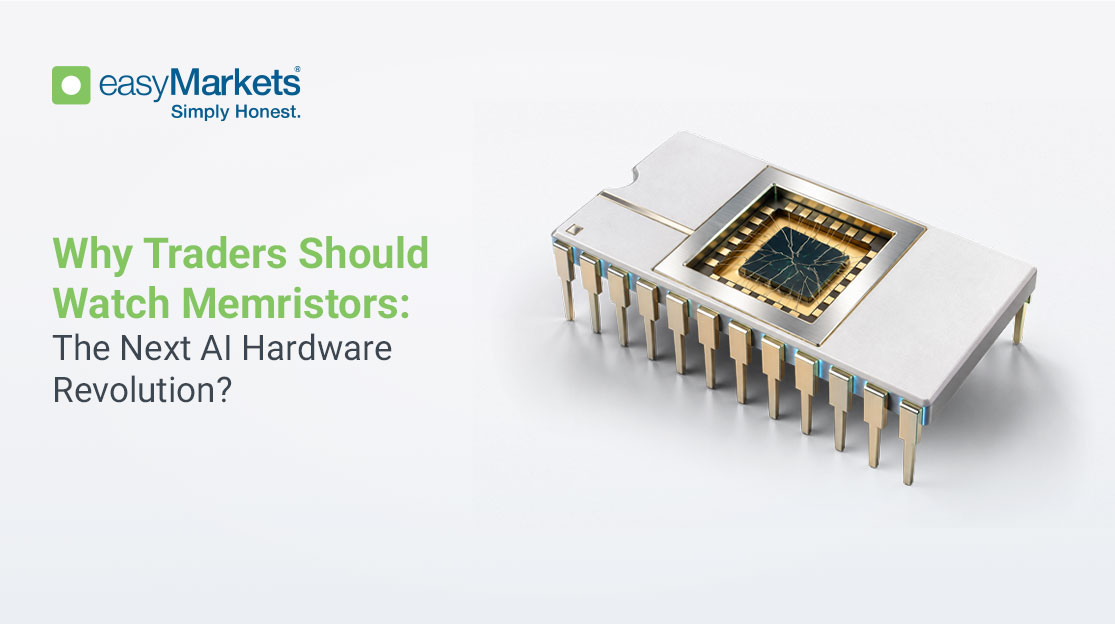
A memristor is a two-terminal electronic component whose resistance changes depending on the electrical signals it has previously received. In simple terms, it can retain information about its previous electrical state, giving the device a form of memory.
The concept was first theorised by electrical engineer Leon Chua in 1971. Practical memristive devices emerged much later as developments in materials science and nanotechnology made the concept more realistic.
What makes memristors particularly interesting is their potential to store information and perform computation within the same system.
Traditional computers generally separate these functions. Processors perform calculations, while memory stores the data required for those calculations. Data must constantly move between the two.
For AI systems processing enormous amounts of data, that movement can consume significant time and energy.
Computing Where the Data Is Stored
Memristors are being investigated for a concept known as compute in memory, where certain calculations can potentially take place directly where the information is stored.
If successful, this approach could reduce data movement and improve efficiency for specific AI workloads, potentially lowering latency and energy consumption.
The key question for markets, however, is not simply whether the technology works in a laboratory. It is whether these potential advantages can eventually become commercially viable products.
Why AI Needs More Efficient Computing
The demand for more efficient computing is being driven by AI itself.
Every new generation of increasingly sophisticated AI models requires greater processing power and more data. This has created a race among technology companies to develop faster and more capable hardware.
But simply adding more computing power comes with economic costs:
-
![tick]()
Higher electricity consumption
-
![tick]()
Rising operating costs
-
![tick]()
More complex cooling requirements
-
![tick]()
Greater infrastructure expenses

The International Energy Agency expects global data-centre electricity consumption to more than double to around 945 terawatt hours by 2030, with electricity consumption from accelerated servers, primarily associated with AI workloads, growing particularly quickly.
This does not mean every future AI chip will consume less electricity. Instead, it highlights why computing efficiency is becoming increasingly valuable.
Companies that can deliver more useful computing performance per unit of energy could gain an advantage as AI becomes increasingly embedded across the economy.
Memristors are one of several technologies being investigated to address this challenge.
Memristors and the Semiconductor Industry
The most direct market connection is the semiconductor sector.
AI has already generated enormous demand for GPUs, high-bandwidth memory, networking equipment and specialised AI accelerators. Semiconductor manufacturers are investing heavily in capacity and advanced designs to keep up with this demand.
Memristors could eventually become part of this broader ecosystem.
However, it would be misleading to view them simply as a future replacement for GPUs. Current research points more toward the possibility of memristive technology becoming part of specialised computing architectures alongside GPUs, CPUs and other forms of advanced memory.
Different technologies could handle different workloads, with memristors potentially being useful for calculations that benefit from processing information directly within memory.
Where Could the Opportunity Lie?
If the technology develops successfully, potential beneficiaries could extend across:
-
![tick]()
Memory technology
-
![tick]()
Semiconductor manufacturing
-
![tick]()
AI accelerators
-
![tick]()
Specialised computing architectures
For traders, this distinction is important. Emerging technologies can reshape an industry without immediately making existing market leaders irrelevant.
Nvidia and the Next AI Hardware Race
Nvidia provides a useful reference point for understanding how quickly the AI hardware market is evolving.
The company remains one of the most important players in AI hardware, while its financial performance has become closely connected to expectations surrounding AI spending. Nvidia recently forecast approximately 70% revenue growth for its next fiscal year, highlighting the strength of current demand for AI computing.
At the same time, Nvidia is expanding its role across a broader hardware ecosystem.
On August 31, 2026, Nvidia announced a $3.5 billion investment in MediaTek, strengthening a partnership involving custom AI chip development designed to integrate with Nvidia’s data-centre architecture.
The significance goes beyond the deal itself.
It highlights how the AI hardware market is increasingly moving toward specialised solutions and complete computing architectures, rather than relying on a single type of processor.
That is precisely the type of environment in which technologies such as memristors could eventually find a commercial role.
Why Data Centres Matter
Data centres are another important part of the memristor story.
The key issue is not simply how many data centres are being built, but the economics of operating them.
AI facilities increasingly rely on specialised hardware running continuously. Even relatively small efficiency improvements can become significant when multiplied across thousands of machines.
If memristor-based systems eventually prove capable of handling certain AI workloads with lower energy consumption and latency, data-centre operators could potentially benefit through:
-
![tick]()
Lower operating costs
-
![tick]()
Greater computing capacity
-
![tick]()
More efficient use of existing infrastructure
The scale of current investment shows why this matters. Anthropic recently agreed to a $35 billion cloud computing deal with Lambda, involving a Texas data centre expected to provide around 350 megawatts of capacity.
For traders, the message is clear: computing efficiency is becoming an economic issue, not just a technical one.
The Connection to Energy Markets
The energy story is broader than memristors themselves.
AI is already becoming an important source of electricity demand, regardless of whether memristors eventually become mainstream. The more interesting question is how improvements in computing efficiency could change the relationship between AI growth and power consumption.
There are two possible outcomes.
More efficient computing could reduce the electricity required for individual workloads. However, lower computing costs could also encourage businesses to use AI more extensively, potentially offsetting some of those efficiency gains.
This distinction matters for traders watching:
-
![tick]()
Utilities
-
![tick]()
Power producers
-
![tick]()
Electricity infrastructure
-
![tick]()
Grid-related companies
For now, memristors should be viewed as one potential efficiency technology within the much larger AI energy debate.
AI Infrastructure and the Copper Connection
The AI buildout also creates a connection to industrial commodities, particularly copper.
Although AI is a digital technology, the infrastructure supporting it is physical. Data centres require electrical equipment, cables, transformers, networking systems and cooling infrastructure, while semiconductor manufacturing depends on a broad industrial supply chain.
Copper is particularly relevant because of its widespread use in electrical infrastructure.
The important point is not that memristors themselves will suddenly increase copper demand. Rather, successful AI expansion could generate demand across industries several steps removed from the technology that initially drove the investment cycle.
This makes the semiconductor story part of a much broader industrial theme.
Beyond AI: The Rise of Neuromorphic Computing
Memristors could also have applications beyond the large data centres dominating today’s AI narrative.
One of the most interesting areas is neuromorphic computing.
Neuromorphic systems aim to reproduce certain characteristics of biological neural networks. Memristors are attractive for these architectures because their ability to store information and participate in computation fits naturally with highly parallel, brain-inspired processing.
Potential applications include:
-
![tick]()
Robotics
-
![tick]()
Autonomous systems
-
![tick]()
Edge computing
-
![tick]()
Connected devices
In these applications, processing information locally could reduce latency and limit the need for constant communication with central data centres.
If these applications become commercially successful, the potential memristor opportunity could extend well beyond the current AI server market.
The Memristor Market Is Growing, but Forecasts Vary
Growing interest in the technology is also reflected in market forecasts.
One 2026 estimate values the global memristor market at approximately $588.9 million in 2025, with projections suggesting it could exceed $12 billion by 2034.
However, forecasts vary significantly depending on how the market is defined and which applications are included. That means traders should focus on the direction of development rather than treating any individual forecast as certain.
The market remains relatively small compared with the established semiconductor industry. The bigger opportunity depends on whether memristors can successfully move from research and prototypes into commercially viable products.
What Are the Risks?
Memristors remain an emerging technology for a reason.
Accuracy and Reliability
One of the biggest challenges is accuracy. Analogue memristor systems can offer attractive energy-efficiency advantages, but real-world devices are not perfectly consistent. Variability, noise and other physical imperfections can introduce errors into calculations.
Research continues to examine how to achieve high computational accuracy without losing the energy advantages that make memristive computing attractive.
Manufacturing at Scale
A successful laboratory prototype is very different from a component that can be produced reliably, cheaply and consistently at enormous scale.
Memristive technology must also integrate with existing semiconductor manufacturing processes and operate reliably alongside other components.
For traders, this distinction is crucial.
A breakthrough research paper may attract attention, but a product that reaches customers could have a much greater impact on companies and markets.
What Should Traders Watch?
The most important signals will be developments showing that memristors are moving closer to commercial adoption.
Technical improvements matter, but partnerships and actual products could provide even stronger signals. Traders should therefore monitor announcements from semiconductor manufacturers, AI companies and research organisations.
Key developments to watch include:
-
![tick]()
New AI accelerator designs These could indicate whether memristive components are becoming part of practical computing systems.
-
![tick]()
Corporate capital expenditure Large semiconductor companies committing significant resources to memristor-based production would suggest the industry sees a commercial opportunity rather than simply a scientific one.
-
![tick]()
Government funding and strategic investment Public support could accelerate research and help emerging technologies move toward manufacturing.
-
![tick]()
Customer adoption and revenue This could be the most important signal of all. It is the point where the story moves from technological potential to measurable business impact.
The Trader's Takeaway
Memristors are more than an interesting technology story because they could eventually influence several areas of the market at once.
Traders do not need to decide today whether memristors will dominate computing ten years from now. A more useful question is:
What could happen to markets if the technology becomes commercially viable?
A credible breakthrough could strengthen sentiment around semiconductor companies by suggesting that the AI hardware cycle has another source of innovation.
A commercially successful product could also lead investors to reassess the competitive landscape, particularly among companies developing advanced memory and specialised accelerators.
For data-centre companies, the potential significance lies in improving the economics of computing.
For energy markets, the key question is whether greater efficiency reduces the power required per workload or instead enables AI usage to expand even faster.
For the Nasdaq, the broader question is whether another technological breakthrough could extend expectations around the growth and profitability of the AI industry.
From Research to Revenue: The Milestones That Matter
Not every memristor headline will have a meaningful impact on financial markets.
A university research announcement may generate interest, while a successful prototype could be more significant. A commercial product would matter even more.
The milestones most likely to change market expectations are:
-
![tick]()
Successful prototypes
-
![tick]()
Commercial products
-
![tick]()
Major manufacturing commitments
-
![tick]()
Integration into AI accelerators
-
![tick]()
Customer adoption
-
![tick]()
Measurable revenue
These developments could have a more lasting impact on expectations for semiconductor companies, AI hardware and the wider technology sector.
The opposite is also possible. If accuracy problems remain unresolved, manufacturing costs stay too high or competing technologies prove more practical, investor enthusiasm could weaken quickly.
The Bigger Picture: AI's Next Challenge Is Efficiency
The AI investment story is gradually becoming a story about efficiency as much as scale.
The industry has spent the past few years building larger models and more powerful computing systems. The next challenge is finding ways to make that computing faster, cheaper and less demanding on resources.
Memristors are one possible answer.
They could eventually become an important component in AI accelerators, neuromorphic systems or other specialised forms of computing. Alternatively, they could remain a promising technology that struggles to overcome the practical challenges between laboratory research and mass production.
At this stage, neither outcome can be taken for granted.
That uncertainty is precisely what makes memristors worth following from a market perspective.
Final Thoughts for Traders
The key is not to trade the memristor headline in isolation.
Instead, traders should watch for evidence that the technology is becoming commercially relevant: real products, corporate investment, manufacturing commitments, accelerator integration and customer adoption. These are the developments that could begin changing expectations for semiconductor companies, AI hardware and the broader technology sector.
The broader lesson is that the next major AI market opportunity may not necessarily come from the companies building the next AI model. It could come from companies solving the underlying hardware challenges that determine how far AI can scale.
Memristors may be tiny electronic components, but the economic question surrounding them is much larger:
Can the next generation of computing deliver more useful AI performance without requiring proportionally more energy?
If the answer eventually proves to be yes, the effects could reach far beyond semiconductors, influencing data-centre economics, technology valuations, energy demand and the wider industrial supply chain.
For traders, that makes memristors worth keeping on the radar today, even if their most important market impact is still some way ahead.
Artificial intelligence has quickly become one of the biggest investment themes in global markets. What began largely as a story about software and AI models has expanded into a much broader technology cycle, driving demand for semiconductors, advanced memory, networking equipment, data centres and electricity.
As the AI industry continues to scale, a critical question is emerging: How can AI systems become more powerful without computing costs and energy consumption rising at the same pace?
One technology attracting growing attention is the memristor.
Memristors remain an emerging technology. They are not replacing the GPUs powering today’s AI boom, and there is no guarantee they will become a mainstream component of future computers. However, their potential to combine information storage and processing could change how certain types of computing are designed.
For traders, that makes memristors a technology worth watching. If the technology becomes commercially viable, it could eventually influence the economics of AI hardware, semiconductor competition and the companies developing the next generation of computing systems.