What 2025’s Gold Fever tells us about traders
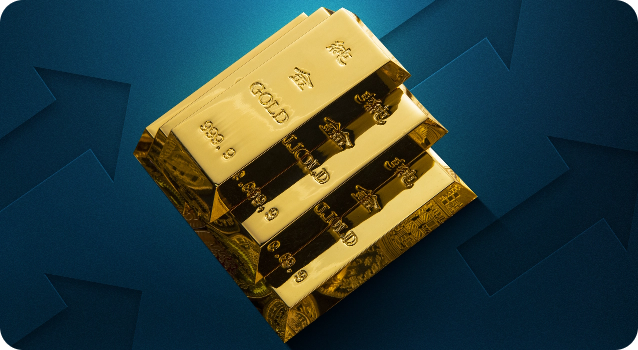
2025 has been a historic year for Gold., marked by a wave of Gold Fever.
On April 22, it first crossed the $3,500/oz mark, setting a new all-time high!
While prices briefly dipped to around $3,400/oz the following day, Gold settled between $3,300–$3,450/oz for months, reinforcing its reputation as a safe-haven asset, signalling way more than just a fleeting spike.
Then, on July 17, Gold surpassed its previous high again, topping $3,540/oz: making it the first time in modern history that Gold broke its all-time high twice in a single calendar year, a clear sign of rising Gold Fever!
But the story didn’t end there....
On October 8 at 08:20 GMT, Gold surged to $4,012/oz, achieving an all-time high for the third time this year! But why exactly?
The power of Tangibility Bias
Tangibility Bias is our natural tendency to value what we can see, touch, or hold. It’s a mental shortcut that offers comfort: a physical asset feels more secure than the abstract.
In 2025, Gold’s repeated all-time highs highlight this Bias in practice and the growing Gold Fever behind it.
As enthusiasm for intangible assets (from AI-driven tech to Crypto) cooled, traders looked for reassurance in what they could actually touch, especially a trusted safe-haven asset. Gold, the most enduring of physical assets, became a crucial point. Its tangible nature gave confidence when abstract markets felt uncertain.
Beyond being milestones, these three historic peaks are signals of a behaviour pattern. Traders are still chasing prices, but they’re also responding to a need for certainty and reliability, which helped intensify the 2025 Gold Fever.
The reason? That’s where it gets a little more complicated.
Navigating the market
Gold rarely moves this dramatically for a safe-haven asset. But in 2025, it did: in a way that clearly reflected Gold Fever.
For a safe-haven asset known for steady movements, three records in one year is unusual. Surges like this happen only when the world is under real pressure.
And traders felt it.
When investors rush into Gold on this scale, it means confidence elsewhere is cracking. Safe-haven assets (especially any trusted physical asset) don’t fill up with no reason, especially during periods of rising Gold Fever. Three record highs in one year point to one thing: global uncertainty is running high, and traders are turning to what they trust most during this Gold Fever, which is trading precious metals. and other safe-haven assets.
To understand why 2025 became the break-out point, we need to look back at the events that built the pressure, long before Gold ever crossed $3,500.
So, what pushed Gold this far?
2025’s Gold Fever explained
The 2025 Gold rally didn’t appear out of nowhere: it was years in the making, shaped by rising economic strain, growing geo-political tension, and a global shift towards greater financial protection.
These pressures help explain not just where Gold is today, but why traders continue to turn to it as their primary safe-haven asset.
The role of the Ukraine conflict in 2022
The Ukraine conflict triggered early moves in Gold. In 2022, Central Banks responded by buying unprecedented amounts to protect reserves, with 1,082 tonnes of Gold bought by year’s end, the largest annual purchase in 55 years.
The scale of these purchases and who made them, revealed a clear connection to the economic and geopolitical shockwaves of the Ukraine conflict:
Türkiye purchased 148 tonnes after inflation surged above 80% on 5 September.
The war pushed global energy prices sharply higher, and with 40% of Türkiye’s natural gas coming from Russia, costs soared.
Global gas prices spiked 400%, oil moved above $120, and Türkiye’s inflation crisis deepened.
As the lira weakened and instability grew, the Central Bank turned to Gold to protect its reserves.
China added 62 tonnes: its first increase in three years.
US sanctions froze about $300 billion of Russia’s reserves, nearly half of its total.
For China, it was a clear warning: dollar-based assets could be vulnerable in a geopolitical dispute. Increasing Gold holdings became a strategic step toward reducing that risk.
Egypt bought 47 tonnes of Gold after a sudden 15% devaluation on 22 March.
The Ukraine conflict cut off access to 75–85% of Egypt’s wheat imports. As ports closed and shipments fell, wheat prices surged, import costs ballooned, and Egypt’s foreign reserves drained rapidly. Gold became a way to stabilise reserve value during the crisis.
By the end of 2022, the shift towards Gold, the ultimate safe-haven asset, and the early embers of Gold Fever were already underway.
The role of the Banking Sector Confidence Crisis in 2023
In 2023, the instability that began in currencies and geo-politics moved into the banking system, carrying Gold’s momentum with it.
On 10 March, Silicon Valley Bank (also known as SVB, the key bank for US tech start-ups) collapsed.
Losses on long-term bonds triggered a $42 billion withdrawal attempt from SVB’s depositors, and the bank couldn’t meet the demand.
Gold, as a key safe-haven asset,reacted fast, rising from the $1,830s on 10 March as early Gold Fever began taking hold, into the $1,900s by 13 March, as traders moved money out of banks and into safe-haven assets.
Confidence cracked across markets. The same weaknesses that broke SVB (large uninsured deposits and heavy unrealised losses) existed in many other banks. Investors began reassessing who might be next.
On 12 March, Signature Bank (a major lender in New York and a key bank for the crypto sector) fell under the same pressure.
Withdrawals accelerated, and capital left vulnerable institutions in favour of traditional safe-haven assets.
Gold climbed again, pushing through $1,920–$1,950.
On 15 March, Credit Suisse (one of Europe’s biggest banks), unravelled after its largest shareholder, Saudi National Bank, said it couldn’t provide more support due to regulatory limits.
Global confidence dropped immediately. Clients withdrew over 60 billion Swiss francs between 15 and 19 March, until regulators announced an emergency takeover.
This moment turned a US banking issue into a global concern, intensifying demand for safe-haven assets.
By 19 March 2023, Gold had surged towards the $1,950–$2,000 zone, inches from its then all-time high.
For the remainder of 2023, Gold held near its highs rather than breaking into a new surge, waiting for the next catalyst.
The Role of China’s Surge in Gold Demand in 2024
By 2024, the momentum built in 2022 and 2023 met its strongest catalyst yet: China’s full embrace of Gold.
China entered the year under pressure:

New-home sales were expected to fall over 24%.
Foreign investors pulled money from Chinese equities.
The yuan weakened past 7.02 per USD.
Chinese households and institutions looked for something they could trust, and they chose safe-haven assets like Gold, with demand surging across the board.
Retail buyers purchased an estimated 336 tonnes of bars and coins. Total domestic consumption reached about 985 tonnes, reflecting stronger reliance on safe-haven assets.
And the central bank kept building its reserves, adding roughly 44 tonnes and lifting reported holdings above 2,191 tonnes.
China became the world’s largest buyer of physical Gold in 2024, adding steady, heavy demand that pushed the entire market higher.
By the end of 2024, the foundation was set.
The human side of the Gold surge
Then 2025 arrived, and Gold took off. But the forces behind this rally weren’t only economic. They were human.
Setting the stage for the three all-time highs that followed in 2025.
Mastering the behaviour
Markets move. But traders decide.
And every decision (from chasing records to running for safety) comes from behaviour, not charts.
Gold’s rise isn’t only a story about inflation, geopolitics, or reserve demand. It’s also a story of a trusted safe-haven asset and certainty, and the lengths traders go to feel it.
To understand why Gold became the comfort of choice in 2025, we need to explore the psychology behind that instinct: Tangibility Bias.
What is Tangibility Bias?
Tangibility Bias is the instinct to trust physical, visible assets more than abstract or intangible ones.
It feels like safety because it feels ‘real’. But this sense of safety comes from a sense of comfort, not actual comfort.
That’s the problem.
True protection in trading comes from risk control, not from whether an asset can be held in your hand. Tangibility Bias creates the illusion that something solid must also be secure, even when its risk is no different, or potentially, even higher.
What are the elements of Tangibility Bias?
Tangibility Bias is built on one core element:
Certainty Preference
Certainty Preference is the instinct to choose what feels clear, stable, and predictable over anything uncertain, even when the ‘certain’ choice isn’t actually safer.
It’s a way the mind reaches for control when the world feels unsteady. And in 2025, this instinct was everywhere.
Physical assets like Gold feel certain, especially when they double as safe-haven assets: you can picture them, hold them, and trust that they won’t suddenly disappear. That emotional clarity creates an illusion of stability, especially when markets are noisy or volatile.
TANGIBILITY BIAS CASE STUDY: The Crypto mining stock crash (2022)
And in 2022, during the FTX collapse, we saw that instinct play out in real time.
During the Crypto bubble of 2021-2022, many traders chose to invest in the Crypto without holding Crypto itself due to its immense volatility. So, they turned to crypto-mining stocks:
Real companies.
Real warehouses.
Real machines.
Real electricity contracts.
They felt safer because they were tangible, but they were not genuine safe-haven assets.
But Tangibility Bias met reality quickly.
The Collapse of FTX
On 8 November 2022 at 10:00 AM ET, Binance walked away from rescuing FTX, a struggling Crypto exchange which did not have the funds to meet customer withdrawals.
FTX began collapsing within hours, freezing withdrawals and halting trading later that afternoon, sending panic through global crypto markets.
The impact on Crypto
As a result:
Bitcoin fell from $19,500 to $16,700 by 9 November, its lowest level since 2020.
Ethereum dropped more than 25%, sliding from $1,500 to $1,100 by 10 November.
By 9:30 AM ET on 11 November, FTX formally filed for bankruptcy.
At that moment, those who trade Cryptocurrency the total crypto market cap collapsed to $820 billion, down from $1.06 trillion on 6 November: a $240 billion wipeout in five days.
The impact on Crypto mining stocks
Unfortunately, hedging on Crypto mining stocks proved to be a futile effort for traders who did so.
Between 8 Nov and 21 Dec 2022, crypto-mining stocks fell 50–90%, erasing roughly $4 billion in market value:
Riot: lost –52% (from $7.50 → $3.60)
Marathon lost–72% (from $14.20 → $4.00)
Core Scientific lost –81% (from $0.27 → $0.05)
Hut 8 lost –45% (from $2.00 → $1.10)
The lesson was clear:
Even tangible assets can collapse when the story behind them breaks.
Difference to Gold
Tangibility Bias doesn’t always lead traders toward real safety. Sometimes it leads them straight into danger.
In 2025, Tangibility Bias pushed traders toward Gold, an asset with:
Real value.
Deep liquidity.
A long history as a safe haven asset.
Gold is still not risk-free, but the foundation beneath it is as solid as Gold.
In 2022, Tangibility Bias pushed traders into crypto-mining stocks. They looked safe because the assets were tangible:
Buildings.
Machines.
Electricity.
Balance sheets.
But none of that protected traders when the story behind crypto cracked. The comfort was tangible, but the safety wasn’t.
That’s the heart of Tangibility Bias:
It can feel wise… even when it isn’t.
It can push you toward stability… or straight into a collapse.
Conquering the cognitive
To break free from Tangibility Bias, traders need a way to rise above what merely feels real. That’s where Construal Level Theory comes in.
What is Construal Level Theory?
Developed by psychologists Yaacov Trope and Nira Liberman, Construal Level Theory says your mind works in two modes:

Concrete Mode, focused on the immediate, the obvious, the thing right in front of you. Tangibility Bias traps traders in Concrete Mode. It makes physical assets feel safer simply because they’re visible and present.

Abstract Mode, focused on the bigger picture, long-term consequences, and strategy.
How does Construal Level Theory help?
Construal Level Theory gives you the counterbalance you need to avoid relying on just one method of thinking.
Instead of reacting to early economic headlines and what feels solid with Concrete Mode, Construal Level Theory encourages traders to engage in Abstract Mode by zooming out, thinking ahead, and asking anchor questions like:
Would I still make this choice a month from now?
What does will this asset look like in six months? In a year?
This way, traders can create distance from the emotional pull of ‘what feels real’, and move towards decisions grounded in logic, strategy, and clarity.
Winning wisdom wrap up
The 2025 Gold rush was purely fuelled mostly by psychology.
Tangibility Bias made physical assets feel safer than ever, and traders followed that comfort at full speed to the most tangible of the safe haven assets.
And yes, on its side, Gold has:
History.
Liquidity.
Global trust.
A reputation as the ultimate safe haven asset.
But here’s the truth every trader needs to remember:
Feeling safe isn’t the same as being safe.
When everyone rushes into the same ‘safe’ trade, crowded positioning creates its own risk. Gold can still swing aggressively when fear flips direction… or when the US dollar surges back into favour.
So, yes: Gold can be the right move. But not because you can hold it.
Because you thought ahead, sized correctly, and managed your risk with intention.
Final thoughts
As of 18 November 2025, Gold is trading around $3,760–$3,820/oz, noticeably below the $4,012/oz peak set on 8 October, but still far above where the year began at around $3,200/oz.
After a rally that delivered three all-time highs in a single year, this cooling phase is the sort of pullback that reflects a natural consolidation.
The forces that pushed Gold higher are still present, just less urgent than they were in September and October.
With a still elevated price and confidence still leaning toward safety, the Gold story remains very much in motion.
Disclaimer:
Please note that the information provided in this article was accurate at the time of writing. Market conditions and economic data can change rapidly. This content is intended for informational purposes only and should not be used as the sole basis for making financial decisions.
2025 has been a historic year for Gold., marked by a wave of Gold Fever.
On April 22, it first crossed the $3,500/oz mark, setting a new all-time high!
While prices briefly dipped to around $3,400/oz the following day, Gold settled between $3,300–$3,450/oz for months, reinforcing its reputation as a safe-haven asset, signalling way more than just a fleeting spike.
Then, on July 17, Gold surpassed its previous high again, topping $3,540/oz: making it the first time in modern history that Gold broke its all-time high twice in a single calendar year, a clear sign of rising Gold Fever!
But the story didn’t end there....
On October 8 at 08:20 GMT, Gold surged to $4,012/oz, achieving an all-time high for the third time this year! But why exactly?
The power of Tangibility Bias
Tangibility Bias is our natural tendency to value what we can see, touch, or hold. It’s a mental shortcut that offers comfort: a physical asset feels more secure than the abstract.
In 2025, Gold’s repeated all-time highs highlight this Bias in practice and the growing Gold Fever behind it.
As enthusiasm for intangible assets (from AI-driven tech to Crypto) cooled, traders looked for reassurance in what they could actually touch, especially a trusted safe-haven asset. Gold, the most enduring of physical assets, became a crucial point. Its tangible nature gave confidence when abstract markets felt uncertain.
Beyond being milestones, these three historic peaks are signals of a behaviour pattern. Traders are still chasing prices, but they’re also responding to a need for certainty and reliability, which helped intensify the 2025 Gold Fever.
The reason? That’s where it gets a little more complicated.