World Cup 2026 Economic Impact:
The Markets Behind Football’s Biggest Event
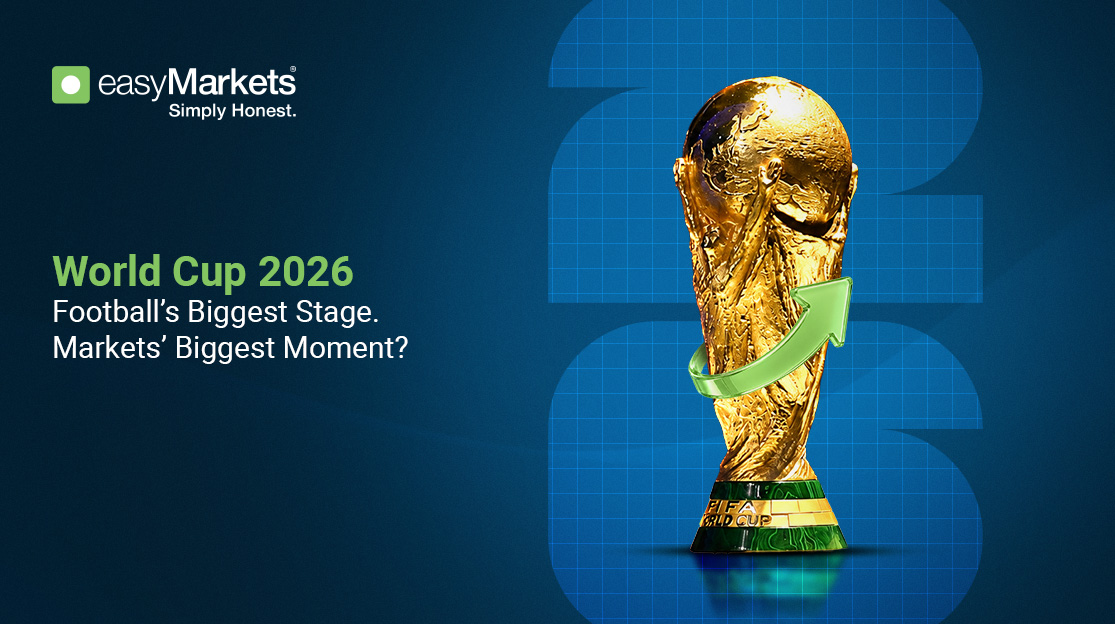
When the 2026 World Cup kicks off, billions of people around the world will be watching the action on the pitch. But behind every match, every goal and every celebration, another game will also be taking place: one driven by travel demand, consumer spending, sponsorships, media rights and global payment flows.
The 2026 edition is the largest World Cup ever held. For the first time, the tournament will be hosted across three countries: the United States, Mexico and Canada. It will feature 48 national teams, 104 matches and 16 host cities, making it not only a major sporting event but also one of the biggest commercial moments of the year.
For traders, the key question is not only who wins the tournament. It is which sectors could benefit from the global attention, spending and market activity created by the FIFA World Cup 2026.
Why the 2026 World Cup Matters for Markets
The World Cup does not move financial markets in the same way as inflation data, interest rates or central bank decisions. However, its scale can create short-term demand across specific industries.
Travel, hospitality, retail, media, payments, restaurants and sportswear brands all have direct exposure to the tournament. Some estimates suggest the broader economic impact of the 2026 World Cup could reach tens of billions of dollars globally, although the effect will not be evenly spread across every city or sector.
The biggest impact is expected to be concentrated in host cities, official venues, tourism hubs and companies with direct commercial links to the tournament.
Tourism and Hospitality: Hotels, Airbnb and Host Cities
The sector that feels the World Cup most directly is hospitality. Official estimates suggest the tournament will attract around 13 million visitors to North America during the event, with more than 21 million hotel nights booked across the three host countries. Tourism spending alone could exceed $8 billion.
Cities like Dallas, Miami, Houston, and Mexico City are reporting maximum hotel occupancy for match days. Airbnb has publicly stated it expects the 2026 World Cup to be the highest-booked event in the platform’s history, surpassing even the Paris 2024 Olympic Games.
However, the impact is not uniform. Cities with fewer assigned matches or lower international connectivity are seeing more modest results. Deutsche Bank analysts note that full-service hotels, corporate event spaces, and luxury hospitality are the clearest beneficiaries, while budget properties have less direct exposure.
The market-relevant figure: Deutsche Bank has built in a 50 to 75 basis point lift in revenue per available room for hotel REITs with greater exposure to host cities.
Airlines and Travel Demand During World Cup 2026
Airlines are another major beneficiary. Data from analytics firm Sojern shows that flight bookings to Houston and Dallas have risen more than 40% compared to the same period last year. Miami is up around 8%, and New York is posting a similar figure.
Long-haul international routes have strengthened the most. Major carriers have deployed larger-capacity aircraft on corridors to host cities from Europe, South America, and Asia. Japan stands out as one of the fastest-growing origin markets, with travelers planning itineraries across all three host countries.
Private aviation and charter services are also reporting unusual volumes. For traders following the airline sector, the tournament provides a concentrated demand boost over a few weeks, which could show up positively in third-quarter earnings.
Retail, Restaurants and Consumer Spending
Fan spending does not stay inside the stadiums. Retail in host cities is receiving a notable boost, and official FIFA merchandise is no longer sold only in specialty stores. Major chains like Macy’s in the United States have incorporated World Cup products into their regular floor space, a sign of how far the tournament’s commercial reach extends.
California alone is projected to see more than $1 billion in additional consumer spending tied directly to the tournament, according to FIFA and World Trade Organization data.
Restaurants and the food and beverage sector are among the businesses best positioned to capture that spending. Analysts particularly flag venues near stadiums, sports bars, and delivery-heavy concepts as the ones with the most positive exposure during the tournament window.
Adidas vs Nike: Sportswear Brands at the World Cup
In the world of sports apparel and equipment, the 2026 World Cup is a competitive arena as intense as the pitch itself. Adidas holds exclusive official kit rights for the tournament and supplies the match ball, a position it has held uninterrupted since the 1970 World Cup in Mexico. That gives it a commercial advantage that is very hard to replicate: its logo appears in every official image of the tournament.
Nike, without being an official tournament sponsor, supplies kits for several of the most popular national teams and has launched high-impact marketing campaigns. The choice to sponsor teams rather than the tournament itself is a strategy that lets it maintain visibility without paying the fees that the exclusive FIFA deal requires.
For investors, the real results for both brands will be visible in third-quarter reports. The metrics to watch are jersey and footwear sales revenue, inventory turnover, and e-commerce growth during the tournament weeks.
Media, Streaming and Advertising Revenue
With more than 5 billion people following the Qatar 2022 tournament across platforms, the World Cup is the largest media event on the planet. The 2026 edition, with 104 matches scheduled in North American time zones, offers advertisers something increasingly rare in the streaming era: massive, simultaneous attention.
Digital streaming platforms and major television networks are competing for viewership. For media companies, every match is an opportunity to sell advertising space at prices few events can justify. Media companies are expected to generate hundreds of millions of dollars in additional ad revenue during the tournament.
At the same time, the growth of digital platforms signals an interesting transition: younger audiences do not watch football on traditional television. Streaming services are capturing a growing share of that audience, translating into subscriber growth opportunities and digital ad revenue for companies well-positioned in that space.
Payments and Financial Technology: Every Tap Counts
One of the less visible but highly relevant angles for financial markets is the payments infrastructure. Visa is the exclusive payment technology sponsor of the 2026 World Cup, a position it has held since 2007 and that FIFA renewed in January 2024.
What makes this partnership powerful is not just brand visibility. Visa is the only accepted payment method across all official ticket sales phases and at point-of-sale locations inside stadiums and fan zones. Every souvenir purchase, every drink inside the stadium, every transaction across any of the 16 official venues goes through Visa’s network. With fans from 48 different countries making payments, the volume of international transactions the tournament generates is significant.
For Mastercard, Visa’s exclusivity means exactly the opposite: being locked out of the official space. That kind of exclusivity is part of what justifies the sponsorship fees that major companies pay FIFA. The price is not just access. It is the cost of keeping a competitor out.
Which Stocks and Sectors Could Benefit from World Cup 2026?
Beyond the excitement, economists are cautious about the tournament’s macro impact. The Allianz Trade analysis estimates a GDP boost of around $6.1 billion in the United States, $1.7 billion in Mexico, and $1.3 billion in Canada during the third quarter. These are real figures but modest relative to the size of those economies.
The impact is neither uniform nor guaranteed. Cities hosting more matches, with better transport infrastructure and stronger international connectivity, are the clearest beneficiaries. Those with fewer matches or very high access costs are seeing results below initial expectations.
There is also an important point analysts are not losing sight of: a portion of international tourist spending simply replaces spending that would have happened anyway, meaning regular travelers who shifted their destination to host cities. That substitution effect limits the true net impact of the tournament on the broader economy.
What Traders Should Be Watching
For market participants, the 2026 World Cup offers specific sector signals rather than a broad macro lift. The sectors with the most direct exposure are:
-
![tick]()
Hospitality and accommodation in host cities: full-service hotels, short-term rental platforms, and entertainment complexes.
-
![tick]()
Airlines serving Dallas, Houston, Miami, and New York: the cities with the highest traveler volumes for the tournament.
-
![tick]()
Sportswear brands: exposure will be measured in third-quarter results, particularly jersey and accessory sales.
-
![tick]()
Media and streaming platforms with broadcast rights: these may report growth in advertising revenue and subscribers.
-
![tick]()
Digital payment companies with presence at official venues: benefiting from the high volume of international transactions the tournament generates.
-
![tick]()
Restaurants, delivery services, and sports bars: especially those near stadiums or built around live match viewing.

The Bottom Line
The 2026 World Cup may be played on the pitch, but its impact will also be felt across markets.
Hotels, airlines, sportswear brands, media companies, restaurants, retailers and payment providers are among the sectors with the clearest exposure. The overall macro impact may be limited, but for companies positioned close to host cities, official venues, sponsorships and fan spending, the tournament could create meaningful short-term opportunities.
For traders, the lesson is simple: global events can create market signals beyond the headline story. The World Cup is not only about football. It is also about travel, spending, advertising, sponsorships, payments and the companies competing for attention during the world’s biggest sporting event.
When the 2026 World Cup kicks off, billions of people around the world will be watching the action on the pitch. But behind every match, every goal and every celebration, another game will also be taking place: one driven by travel demand, consumer spending, sponsorships, media rights and global payment flows.
The 2026 edition is the largest World Cup ever held. For the first time, the tournament will be hosted across three countries: the United States, Mexico and Canada. It will feature 48 national teams, 104 matches and 16 host cities, making it not only a major sporting event but also one of the biggest commercial moments of the year.
For traders, the key question is not only who wins the tournament. It is which sectors could benefit from the global attention, spending and market activity created by the FIFA World Cup 2026.