Trump Tariffs and Global Markets:
What Traders Should Watch in 2026
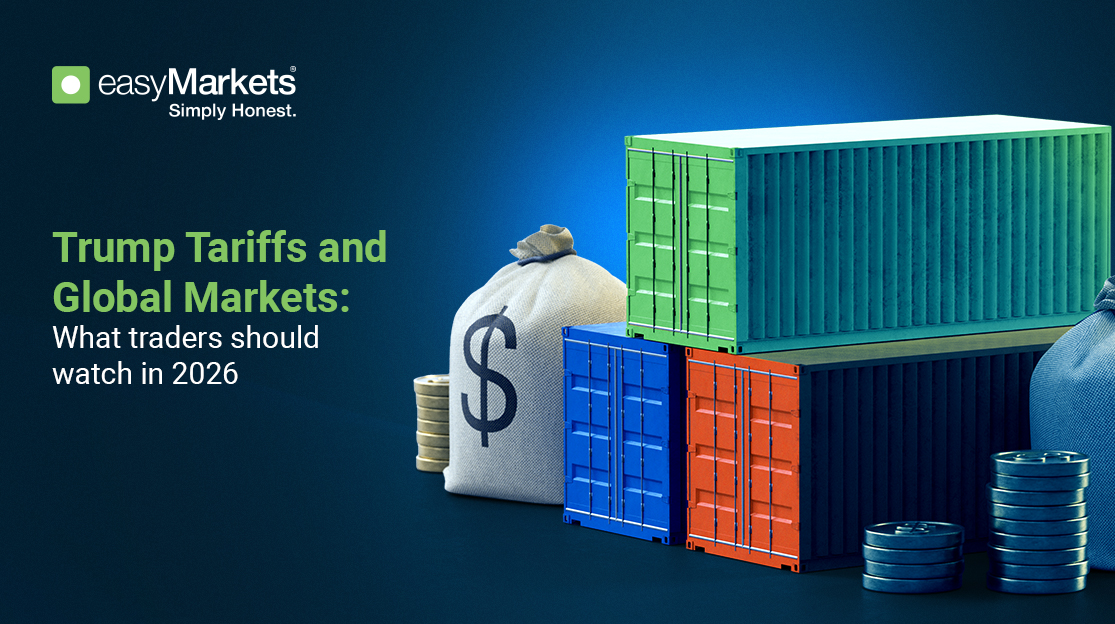
Since President Trump returned to power in January 2025, United States (U.S.) trade policy has undergone an unprecedented transformation. What began with tariffs on Canada, Mexico, and China has expanded into a system covering dozens of countries, entire industrial sectors, and in some cases, has been deployed as a geopolitical pressure tool. For investors and traders, the trade tensions resulting from this policy are no longer a distant risk. They are the environment in which markets operate today.
The current picture is complex. The 10% global tariff applied under Section 122 of the Trade Act of 1974 expires on July 24, 2026. What comes next could be equally or more aggressive. Yet Trump has made clear he plans to impose new rounds of tariffs this summer. Global markets are already beginning to price that in.
How the current tariff regime came about
What sets Trump’s tariff policy in 2026 apart from anything in recent history is its geopolitical scope. Tariffs are no longer used solely as protection for domestic industry. They are being used as diplomatic pressure tools.
In January 2026, Trump announced a 25% tariff on all countries trading with Iran. In February, the administration raised the global baseline rate from 10% to 15% with immediate effect. In April, tariffs were proposed on Germany and France linked to the Greenland dispute. Asian markets, European exchanges, and Wall Street futures all reacted with sharp volatility at each announcement.
The trade war has moved beyond a bilateral standoff between major powers. It has become a multidimensional board where U.S. trade policy can activate economic sanctions against any country that takes geopolitical positions contrary to the White House. For global markets, that means any foreign policy headline now has the potential to move financial market prices.
One figure that captures the scale of the shift: according to Yale University’s Budget Lab, Trump tariffs pushed the average U.S. import duty to 16.8% in 2025, the highest level since 1935. That is a historic fact that markets are still working through.
Forex: The dollar caught between two forces
The effect of tariffs on the currency market does not follow a single logic. In theory, tariffs should strengthen the dollar. By making imports more expensive and narrowing the trade deficit, they reduce the supply of dollars flowing abroad. And at certain points, that is exactly what has happened.
However, the U.S. dollar forecast for 2026 has turned out to be far more complicated. After the Supreme Court struck down the IEEPA tariffs in February, the Dollar Index (DXY) dropped to 97.51 in a single session. Uncertainty over U.S. trade policy weighs on confidence in the dollar almost as much as a tariff approval lifts it.
The most sensitive pairs in this environment have tended to be:
-
![tick]()
EUR/USD, which has swung sharply with every tariff announcement targeting Europe.
-
![tick]()
USD/JPY, which rises when Treasury yields climb on imported inflation expectations.
-
![tick]()
AUD/USD, exposed through Australia’s deep trade relationship with China, one of the countries most affected by U.S. tariffs.

The factor that most complicates the forex read is this: tariffs generate imported inflation, which keeps rates higher for longer and supports the dollar. But at the same time, they weigh on economic growth, which pulls the dollar lower. Traders need to watch which of those two forces is dominant at any given point in the cycle.
Gold price outlook for 2026: tariffs and safe-haven assets
Of the major commodities, gold has responded most visibly to the environment of trade uncertainty. Every new Trump tariff announcement has pushed investors toward safe-haven assets, and gold has benefited from that dynamic consistently. Gold prices hit historic highs during 2025 and have remained elevated through 2026.
Goldman Sachs has cited structurally higher central bank demand as one of the pillars of the metal’s price. The World Gold Council reported that central banks bought more than 333 tonnes of gold in the quarter following Trump’s November 2024 election victory, a 54% year-on-year increase. The underlying message is clear: in a world where tariffs and trade tensions redistribute global risk, gold works as a hedge against both inflation and geopolitical uncertainty.
Oil prices: a more mixed picture
Oil has been harder to read. The threat of 500% tariffs on countries importing Russian crude caused temporary price spikes. However, Goldman Sachs projects the global oil market will remain in surplus during 2026, with Brent around $60 per barrel in the fourth quarter, assuming no serious supply disruptions linked to Iran.
The risk to watch in the second half of 2026 is the combination of new tariff rounds with any escalation in the Strait of Hormuz. That combination could shift oil prices sharply and quickly, with cascading effects on global inflation and central bank decisions.
Central banks: caught between inflation and growth
For central banks, Trump tariffs represent an unenviable dilemma. Tariffs are inflationary by nature: they raise the cost of imported goods and push up production costs. But at the same time, they weaken global trade and slow economic growth. Those two forces point in opposite directions for monetary policy.
The Federal Reserve is the most complex case. Inflation in the United States remains above the 2% target, making it very difficult to justify rate cuts in the near term. Goldman Sachs estimates that U.S. consumers and businesses absorbed 82% of the tariff cost in October 2025, and that 67% of the total burden will fall on consumers by July 2026.
The European Central Bank faces a different kind of pressure. If tariffs on European goods become entrenched, Eurozone growth would be hit more directly than inflation, giving the ECB grounds to continue cutting rates. That could widen the rate differential with the Fed and weigh on EUR/USD.
Central banks in emerging economies are also under pressure. Countries like India, Brazil, and Turkey, direct or indirect targets of U.S. tariff policy, are facing capital outflows and currency pressures that reduce their room for monetary maneuver.
Stock market volatility: resilience with latent risks
Despite the noise, equity markets have shown remarkable resilience. The S&P 500 has gained 9% year to date in 2026, and since Trump’s election in November 2024, the index has generated a total return of nearly 30%. First-quarter 2026 corporate earnings, driven largely by artificial intelligence investments, beat market expectations.
However, stock market volatility remains elevated. Every new tariff announcement, every court ruling on their legality, and every response from affected economies triggers sharp short-term moves. The Euro STOXX 50 fell 3% in a single session when Trump proposed 50% tariffs on European goods. The S&P 500 gave up more than 1.6% on the same news.
Wall Street’s consensus for year-end 2026 puts the S&P 500 at around 7,850 points, implying roughly 5% upside from current levels. But that base case assumes the summer’s new tariffs do not exceed market expectations and that inflation does not force the Fed into an even tighter stance. If either variable surprises to the upside, stock market volatility could surge sharply.
The sectors most exposed to tariff risks are manufacturing, autos, consumer technology, and retailers with global supply chains. Defence, domestic energy, and financial services have shown greater resilience within this environment.
Risk sentiment: between adaptation and caution
Risk sentiment in global markets has evolved from the initial panic of the first tariff announcements toward something closer to pragmatic adaptation. Investors have built trade uncertainty into their framework as a permanent feature of the environment, not a temporary shock.
That does not mean the risk has gone away. It means markets have learned to operate within it. In each tariff escalation episode, the pattern is recognizable: the dollar moves based on inflation versus growth expectations, gold rises as a haven, oil reacts to pressure on affected producer countries, and shares in sectors exposed to imports or exports sell off hard.
The most immediate event that could shift that sentiment dramatically is the expiration of the 10% global tariff on July 24, 2026. Whatever the Trump administration announces as a replacement, whether new sector-specific tariffs, country-by-country rates, or a combination of both, will set the tone for markets throughout the entire second half of the year.
For traders, the key is to be positioned ahead of the news rather than reacting after the fact. U.S. trade policy headlines move markets in seconds. Having clarity on which assets react to which type of announcement is today as important a competitive edge as any technical analysis.
What traders should watch
In the immediate horizon, these are the events and variables most likely to move markets in relation to Trump’s tariff policy:
-
![tick]()
24 July, 2026. Expiry of the 10% global tariff under Section 122. What replaces it will be the most important tariff event of the second half.
-
![tick]()
U.S. inflation data (CPI/PCE). It sets the Fed’s room to maneuver and the direction of the dollar. Any upside surprise reinforces the higher-for-longer rate scenario.
-
![tick]()
U.S. and EU trade negotiations. European goods currently pay 15% under the existing deal. Any breakdown of that agreement would trigger EUR/USD volatility.
-
![tick]()
Iran and Strait of Hormuz headlines. It directly links to oil prices and global risk sentiment.
-
![tick]()
Dollar Index (DXY) and XAU/USD. The two most immediate barometers of how the market is reading each new tariff development.
-
![tick]()
FOMC and ECB meetings. The rate differential between both institutions will remain one of the main drivers of EUR/USD through the second half of 2026.
Conclusion
Trump tariffs are not a one-off event. They are the new architecture of global trade, and financial markets are already operating within that reality. The forex market, commodities such as gold and oil, central banks, and stock markets are all responding, in different degrees and with different logics, to the same underlying force: uncertainty over U.S. trade policy.
For traders, that means the ability to read trade policy headlines and quickly translate them into market implications has become a fundamental skill. It is not about predicting what Trump will do next. It is about understanding which assets react to which type of announcement, and being positioned ahead of the move.
Since President Trump returned to power in January 2025, United States (U.S.) trade policy has undergone an unprecedented transformation. What began with tariffs on Canada, Mexico, and China has expanded into a system covering dozens of countries, entire industrial sectors, and in some cases, has been deployed as a geopolitical pressure tool. For investors and traders, the trade tensions resulting from this policy are no longer a distant risk. They are the environment in which markets operate today.
The current picture is complex. The 10% global tariff applied under Section 122 of the Trade Act of 1974 expires on July 24, 2026. What comes next could be equally or more aggressive. Yet Trump has made clear he plans to impose new rounds of tariffs this summer. Global markets are already beginning to price that in.